People Operations That Scale.
How a fast-hiring financial-sector team turned onboarding from a multi-day scramble into minutes — and started seeing flight risk a month before the resignation.
Told without names

When a company hires more than eighty people a month, the people team's work stops being a series of tasks and becomes a logistics problem. Every new hire touched a dozen systems and forms. Nothing was hard, exactly. There was just a lot of it, and it all had to happen in the right order, every time, for every person.
The challenge
Two things suffered, and both got worse as hiring sped up. Onboarding took days per hire, because it ran across many tools and depended on people remembering each step. At eighty hires a month, that is a full-time job spent on coordination alone.
The second problem was quieter and more expensive: retention risk surfaced too late. The signals were all there — a stalled tenure, a comp gap, a drop in engagement, a manager change — but scattered across systems no one had time to read together. By the time it showed up, it usually showed up as a resignation.
Our approach
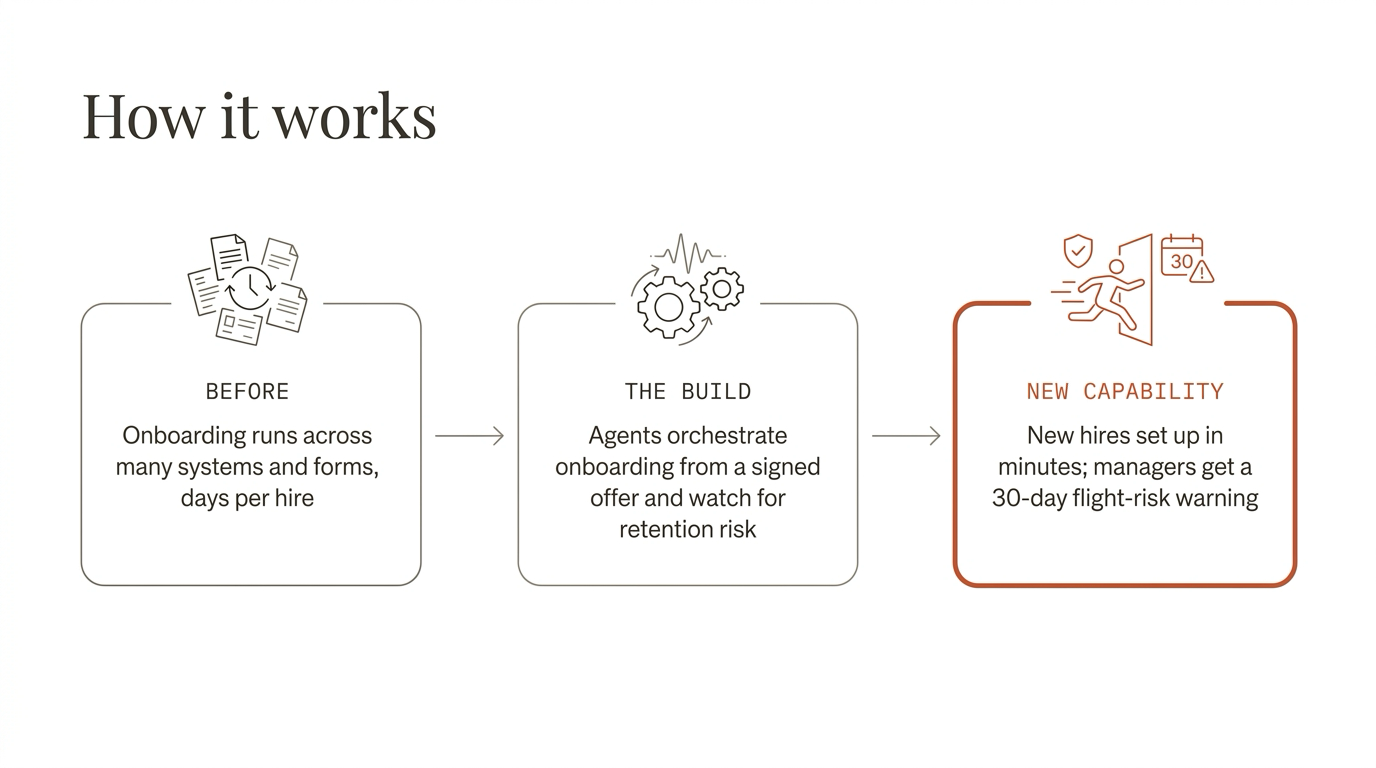
We connected their HR systems and built agents around the two moments that mattered most. The first orchestrates onboarding the instant an offer is signed: accounts, access, a buddy, and a thirty-sixty-ninety plan, provisioned automatically and in the right order.
The second reads the signals already sitting in their tools — tenure, comp, engagement, a recent manager change — and quietly flags who is at risk, early, to the one person who can do something about it. No new dashboard to check; the warning comes to the manager.
A new hire is set up in minutes instead of days, and managers get a thirty-day warning on flight risk instead of a resignation letter.
Neither of those is really a time saving. They are things the team simply could not do before, at this hiring cadence — onboard instantly, and intervene while there is still time to change the outcome.
The result
The people team got out of the coordination business and back into the people business. Onboarding runs itself; retention conversations now happen while they can still change someone's mind.