Reports That Write Themselves.
How an engineering team stopped hand-assembling technical reports and started generating them straight from live data — with a human still signing off on every one.
Told without names

Some of the most valuable work in an engineering team is also the most tedious: the report. Pulling numbers from monitoring systems, running the calculations, formatting it all into something a client or a regulator will accept. Skilled engineers spent hours on it, and the backlog only grew.
The challenge
The reports were assembled by hand, from live monitoring data and a set of engineering calculations that had to be exactly right. It was slow, repetitive, and easy to fall behind on — the kind of work that is too important to skip and too dull to enjoy.
Because it was manual, it could only happen as often as someone had time for it. A report that should have been a routine check became an event you scheduled around. The data was live; the reporting was not.
Our approach
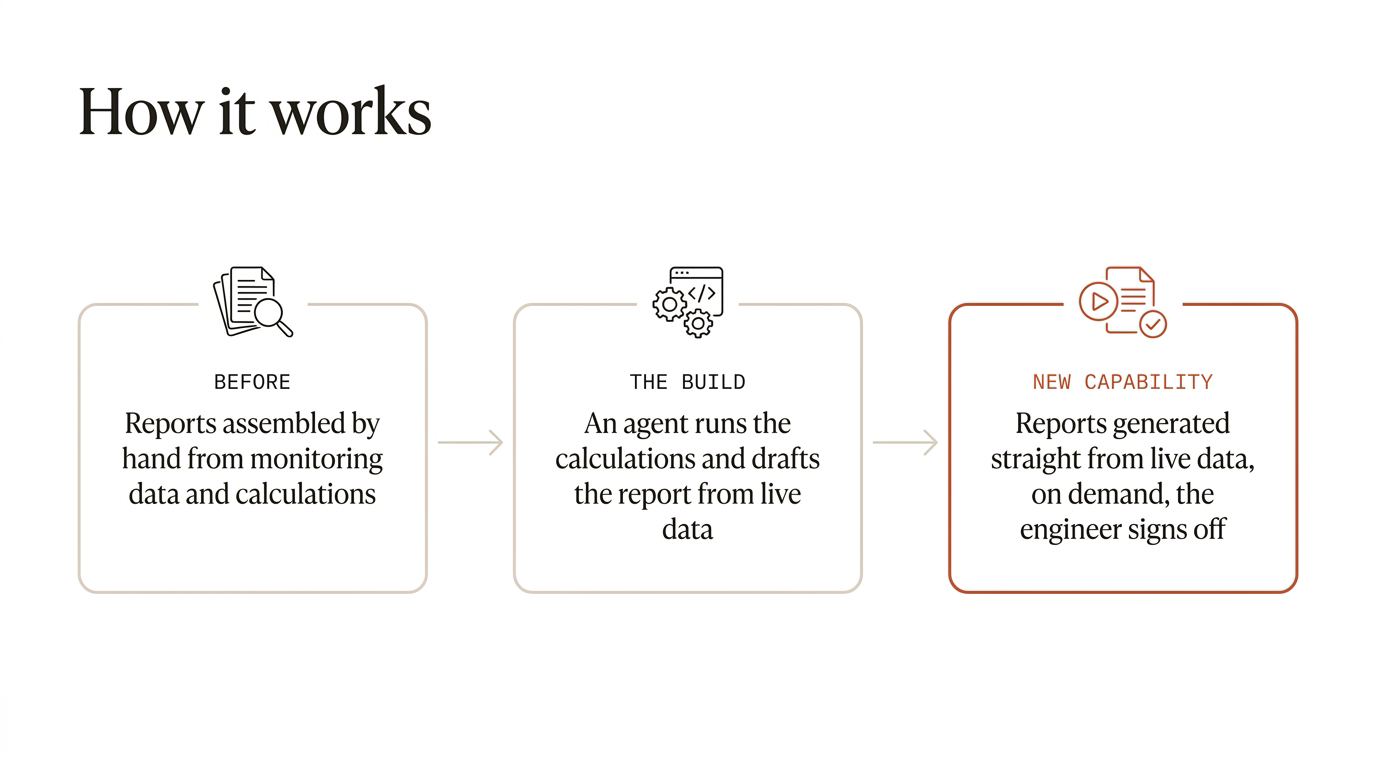
We connected the monitoring data and built an agent that does the assembly: it pulls the readings, runs the same calculations the team had refined over years, and drafts the full report in their format.
Crucially, the engineer stays in the loop. Every report is theirs to review and sign off on before it goes anywhere. The judgment that takes expertise stays human; the assembly that takes hours does not. That line — human judgment, automated labor — is the whole design.
Reports are generated straight from live data, on demand — so the team produces them in a fraction of the time, and can run them far more often than before.
That frequency is the quiet win. A report that used to be a quarterly slog can now run whenever it is useful — before a client call, after an anomaly, on a schedule — because the cost of producing one dropped to almost nothing.
The result
The work that needed a human kept its human; the rest got handled. The backlog cleared, and reporting went from a bottleneck to something the team barely thinks about.